Punjab SIR 2026 from house visits to the final roll
House visits began in June and the final roll came out in October. Panj Teer’s ASDD count covers all 23 districts and 117 Assembly constituencies.
ਲੇਖ ਦੀ ਮੂਲ ਭਾਸ਼ਾ: ਅੰਗਰੇਜ਼ੀਭਾਸ਼ਾ ਦਾ ਸਵਿੱਚ ਨੈਵੀਗੇਸ਼ਨ ਬਦਲਦਾ ਹੈ। ਲੇਖ ਆਪਣੀ ਮੂਲ ਭਾਸ਼ਾ ਵਿੱਚ ਹੈ।
Punjab’s Special Intensive Revision, or SIR, began with house-to-house work on 25 June 2026 and reached the publication of the final voter roll on 12 October. The exercise covered all 117 Assembly constituencies.
Along the way, election officials published lists of names recorded as absent, shifted, dead or duplicate. These are called ASDD lists. Panj Teer Research’s count of the available booth files comes to 20,66,608 listings, or about 20.7 lakh.
Those lists show the reasons recorded against names and where the names were listed. The final roll is a separate publication. It contains about 2.01 crore voters, according to the figures released by the Chief Electoral Officer’s office.
What was checked during SIR
SIR is an exercise to check and prepare electoral rolls. In Punjab, Booth Level Officers, usually called BLOs, visited homes to distribute and collect enumeration forms. Election officials then prepared the draft roll, received claims and objections, and carried out the notice and decision process before publishing the final roll.
The enumeration form asked for existing voter details, family details and information linking the voter, or a relative, to the rolls from the earlier intensive revision. The accompanying information sheet explained the documents that could be required when an earlier entry could not be matched or needed further checking.
The Election Commission announced Punjab’s inclusion in Phase III on 14 May. The eligibility reference date for the revision was 1 October 2026. The timetable was revised during the exercise: house visits continued until 3 August, and the draft and final publications moved to 13 August and 12 October.
| When | Stage | What happened |
|---|---|---|
| 14 May 2026 | Announcement | ECI announced Phase III of SIR, including Punjab. |
| 25 June to 3 August | House visits | BLOs distributed and collected enumeration forms. The closing date was extended during the exercise. |
| 13 August | Draft voter roll | The draft roll was published for people to check their names and details. |
| 13 August to 12 September | Claims and objections | People could seek inclusion or corrections and file objections. |
| 13 August to 8 October | Notices and decisions | Officials examined records, heard cases and decided claims and objections. |
| 12 October | Final voter roll | The final roll was published for all 117 Assembly constituencies. |
Publication of the draft opened a period in which people could check the list and submit applications. Claims and objections ran until 12 September. The notice and disposal phase continued until 8 October. The CEO’s account says registration officers held hearings and examined documents and BLO reports before taking decisions.
What the ASDD records contain
The booth files record four reasons: permanently shifted, death, untraceable or absent, and already enrolled. “Already enrolled” is the label used for the duplicate category in the files counted here.
Permanently shifted is the largest category, with 9,44,111 names, or 45.7% of the total. Death accounts for 5,74,569 names. Another 4,28,784 are marked untraceable or absent, and 1,19,144 are marked already enrolled.
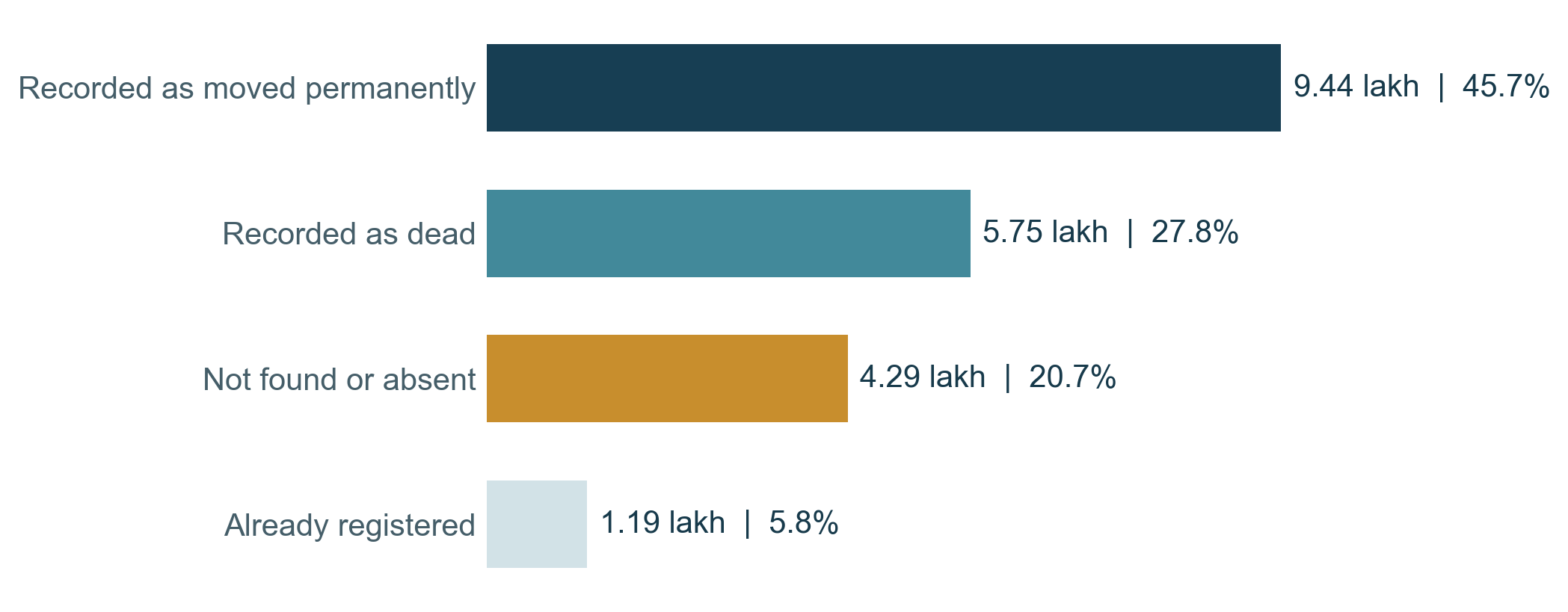
Reasons recorded in the available ASDD booth lists. Each percentage is a share of the names in those lists. Source: CEO Punjab; count by Panj Teer Research.
A shifted entry does not say where the person moved. The files do not distinguish a move within Punjab from a move to another state or another country. An untraceable or absent entry is the reason recorded in the list, rather than a record of the person’s migration history.
The 20.7 lakh figure is a count of ASDD listings. It does not establish how many of those individual names remained outside the final roll. Panj Teer has not matched each listed name to the October final roll.
Ludhiana has the largest district count
Ludhiana records 4,16,088 names, the highest district count in the available files. Amritsar follows with 2,42,742, Jalandhar with 1,84,997, SAS Nagar with 1,53,704 and Patiala with 1,38,620. Together, these five districts account for about 55% of the statewide ASDD count.
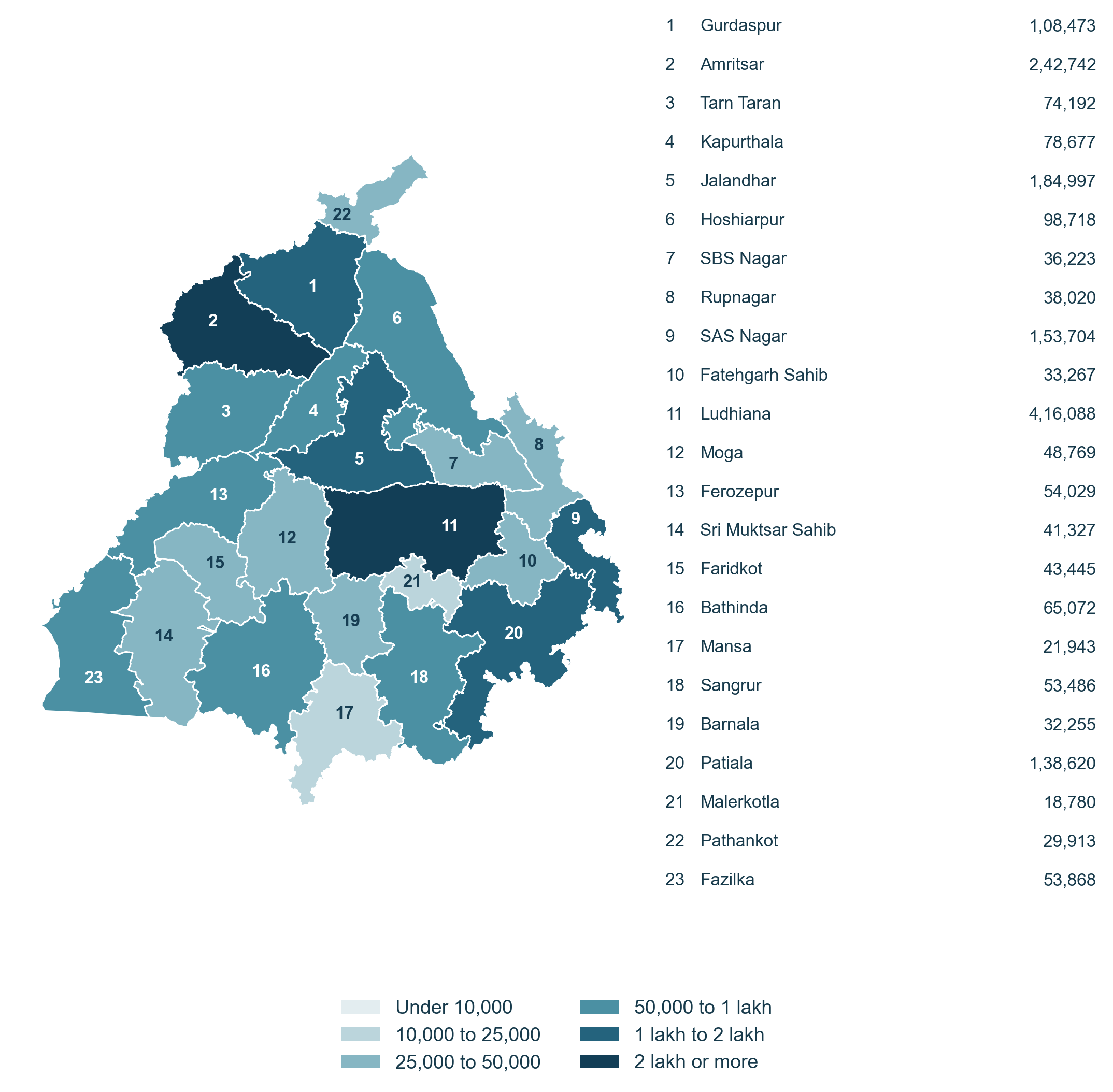
ASDD names by district. Darker colours show larger numbers of listed names. The map does not show a percentage of registered voters. Counts: CEO Punjab. District outlines: LGD Districts 2024 via Bharatlas.
The reasons differ across these districts. Ludhiana records 1,90,415 names as permanently shifted and 1,26,378 as untraceable or absent. SAS Nagar records 69,961 and 53,870 respectively. Patiala records 61,153 as permanently shifted and 43,617 under death.
The district appendix below gives all four reasons for every district, alongside the total number of names. The figures are absolute counts. A district with a larger count is not necessarily a district with a larger share of its voters on the lists.
Kharar leads the constituency count
Kharar has 55,618 names in the available ASDD files. Ludhiana East follows with 54,493 and Ludhiana North with 51,217. Ludhiana South has 49,957, Dera Bassi 49,845 and Sahnewal 48,853.
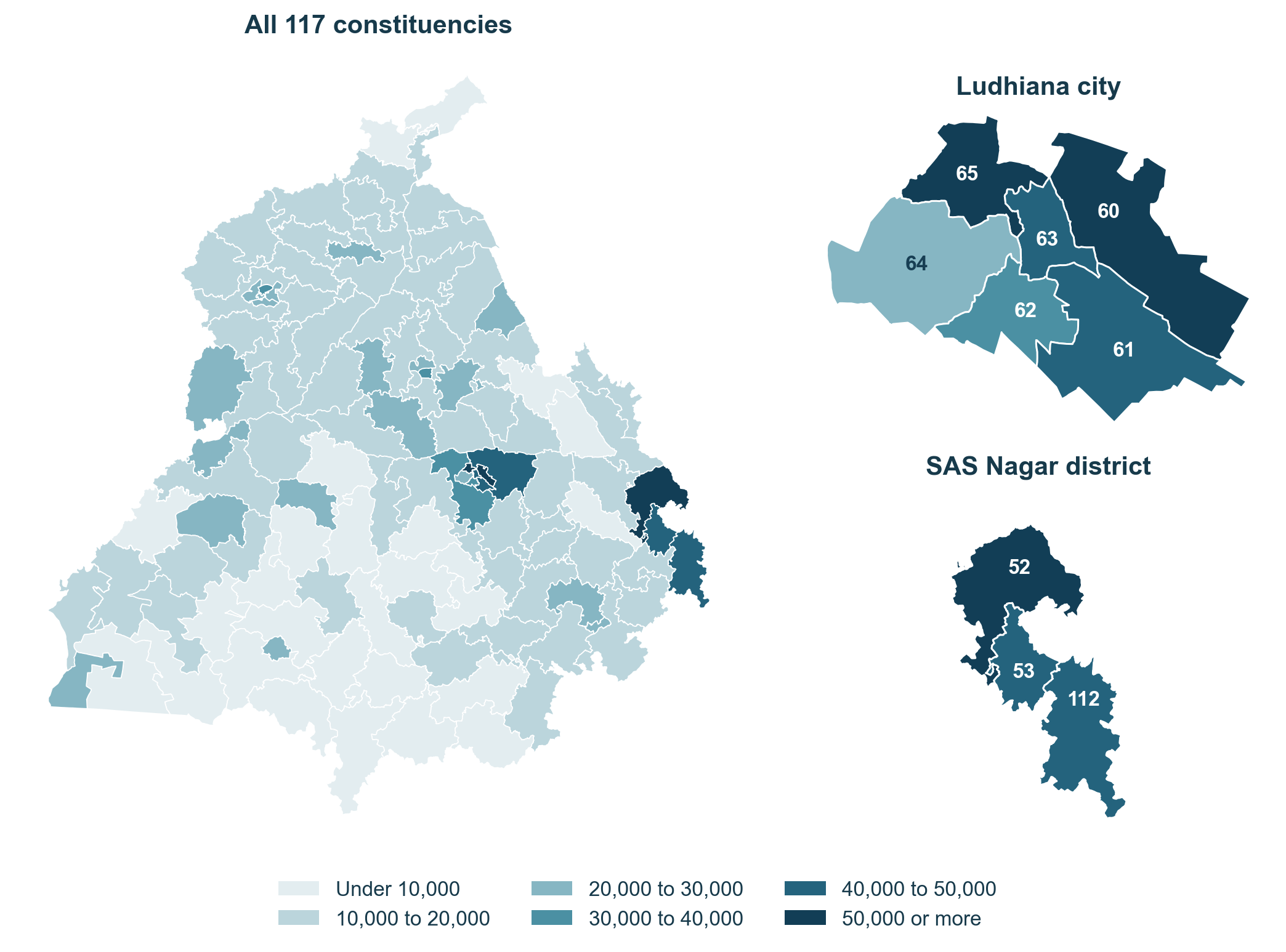
ASDD names across all 117 Assembly constituencies, with enlarged views of Ludhiana city and SAS Nagar district. Numbers identify constituencies. The supplied constituency outlines are illustrative. Counts: CEO Punjab.
| No. | Constituency | District | Names listed |
|---|---|---|---|
| 52 | Kharar | SAS Nagar | 55,618 |
| 60 | Ludhiana East | Ludhiana | 54,493 |
| 65 | Ludhiana North | Ludhiana | 51,217 |
| 61 | Ludhiana South | Ludhiana | 49,957 |
| 112 | Dera Bassi | SAS Nagar | 49,845 |
| 59 | Sahnewal | Ludhiana | 48,853 |
| 53 | S.A.S. Nagar | SAS Nagar | 48,241 |
| 63 | Ludhiana Central | Ludhiana | 40,032 |
| 15 | Amritsar North | Amritsar | 37,496 |
| 66 | Gill | Ludhiana | 36,997 |
There is also variation within districts. In Ludhiana South, 36,998 of the 49,957 listed names are marked untraceable or absent, a share of 74.1%. In Kharar, the corresponding count is 25,519, or 45.9% of its listed names. These percentages describe the ASDD lists, rather than all registered voters in the constituencies.
What the final roll shows
The CEO’s office reported 2,01,00,727 voters in the final roll published on 12 October. The total was 2,14,61,043 before the review and 1,93,94,435 in the draft published on 13 August.
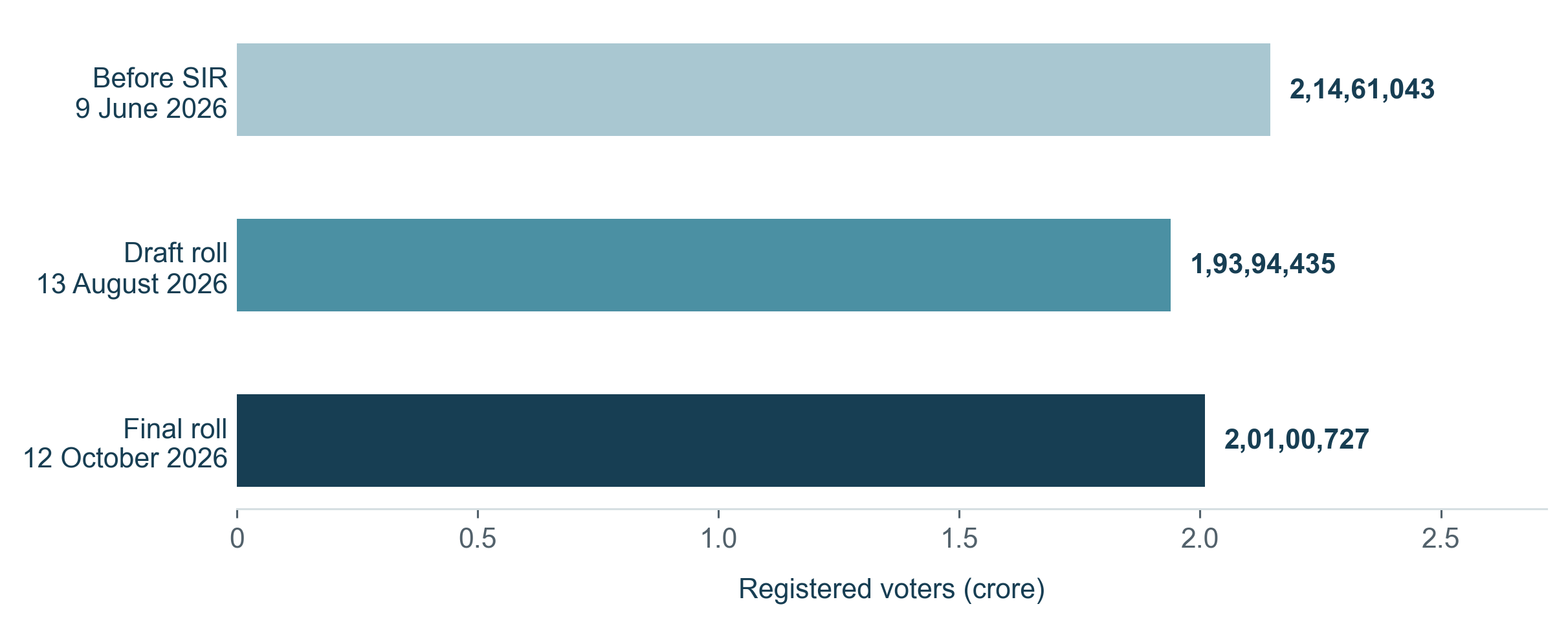
Statewide voter totals at three stages. The figures released by the CEO’s office were reported by NDTV and Yes Punjab on 12 October. These are voter-roll totals, rather than counts in the ASDD reason categories.
The final total is 13,60,316 lower than the pre-review total, a net fall of about 6.3%. It is 7,06,292 higher than the draft. These differences compare the size of the rolls. They do not identify which particular names were added back, newly enrolled or removed.
The CEO’s account also reported 7,97,263 new enrolments during the exercise. Separately, it reported notices to 35,49,036 electors and 86,038 people marked ineligible after verification and reasoned orders. The notice-stage figure is not the statewide ASDD count.
The position after publication
The October final roll is available through the CEO Punjab website and the Election Commission’s voter portal, as well as with district election offices, registration officers and BLOs. Eligible people left out of the final roll can apply for inclusion using Form 6, according to the CEO’s announcement.
Punjab was also named among the states and Union Territories covered by a separate Special Summary Revision, reported by Akashvani on 16 October, with 1 January 2027 as its eligibility reference date. That report describes a summary update without a fresh round of house-to-house visits.
Request the constituency data
The detailed Excel workbook is available on request from Panj Teer Research. It contains all 117 constituencies, the four recorded reasons, totals and the number of booth files counted or unavailable. A district sheet and a list of the unavailable files are included.
Contact Panjteer on Instagram to request the constituency data.
District appendix
Names recorded in the available ASDD lists, grouped by district. The four reason columns add up to the total. The figures describe these lists and are not a district breakdown of the final reduction in registered voters.
| District | Names listed | Permanently shifted | Death | Untraceable or absent | Already enrolled |
|---|---|---|---|---|---|
| Ludhiana | 4,16,088 | 1,90,415 | 80,050 | 1,26,378 | 19,245 |
| Amritsar | 2,42,742 | 1,17,826 | 59,905 | 46,866 | 18,145 |
| Jalandhar | 1,84,997 | 94,356 | 50,520 | 31,160 | 8,961 |
| SAS Nagar | 1,53,704 | 69,961 | 21,772 | 53,870 | 8,101 |
| Patiala | 1,38,620 | 61,153 | 43,617 | 25,779 | 8,071 |
| Gurdaspur | 1,08,473 | 49,580 | 30,452 | 19,204 | 9,237 |
| Hoshiarpur | 98,718 | 48,512 | 28,475 | 15,571 | 6,160 |
| Kapurthala | 78,677 | 39,336 | 21,746 | 15,075 | 2,520 |
| Tarn Taran | 74,192 | 37,568 | 20,956 | 8,688 | 6,980 |
| Bathinda | 65,072 | 28,313 | 23,299 | 9,802 | 3,658 |
| Ferozepur | 54,029 | 24,442 | 20,707 | 6,156 | 2,724 |
| Fazilka | 53,868 | 21,427 | 23,091 | 6,649 | 2,701 |
| Sangrur | 53,486 | 18,726 | 23,849 | 7,845 | 3,066 |
| Moga | 48,769 | 21,606 | 14,551 | 9,516 | 3,096 |
| Faridkot | 43,445 | 16,273 | 18,514 | 6,986 | 1,672 |
| Sri Muktsar Sahib | 41,327 | 16,126 | 17,157 | 6,529 | 1,515 |
| Rupnagar | 38,020 | 16,160 | 11,614 | 6,943 | 3,303 |
| SBS Nagar | 36,223 | 20,342 | 7,338 | 7,032 | 1,511 |
| Fatehgarh Sahib | 33,267 | 13,351 | 12,299 | 5,157 | 2,460 |
| Barnala | 32,255 | 11,727 | 14,099 | 4,150 | 2,279 |
| Pathankot | 29,913 | 13,353 | 11,415 | 3,678 | 1,467 |
| Mansa | 21,943 | 8,308 | 9,529 | 2,950 | 1,156 |
| Malerkotla | 18,780 | 5,250 | 9,614 | 2,800 | 1,116 |
| Punjab | 20,66,608 | 9,44,111 | 5,74,569 | 4,28,784 | 1,19,144 |
About the figures
The booth-list count is based on files downloaded on 22 October 2026. It covers 25,286 of the 25,332 files listed on the portal. The remaining 46 files were unavailable. Their counts are unknown and have not been estimated. The research workbook, available on request, identifies the affected constituencies and booth parts.
Names are counted as they appear in the files. The total includes 11 extra listings with repeated non-blank voter IDs. Counting each distinct non-blank voter ID once gives 20,66,597. This is a check on repeated IDs, not a finding about the identity of the people concerned.
The statewide pre-review, draft and final voter totals come from the CEO’s figures as reported on 12 October. The district and constituency figures come from Panj Teer’s count of the ASDD booth files. No name-by-name comparison with the final roll has been completed. A constituency total with unavailable files covers only the files that could be counted.
District map outlines use LGD Districts 2024 via Bharatlas. Constituency outlines come from the supplied research files and are illustrative. Map colours show counts, not removal rates or percentages of the electorate. SAS Nagar and SBS Nagar are shortened district names.
Sources
-
ECI Phase III announcement and original schedule, 14 May 2026
-
Enumeration form and information sheet on the Jalandhar district portal
-
NDTV report of the CEO’s final-roll figures, 12 October 2026
-
Yes Punjab account of the CEO’s announcement and procedure, 12 October 2026
-
Akashvani report on the Special Summary Revision, 16 October 2026